
Most generator failures on long jobs are not mechanical. The engine is fine, the set is well maintained, and the job stops anyway because the fuel ran out. It is one of the most common ways temporary power lets a site down, and it is almost entirely avoidable with some planning.
On a single-shift job, keeping fuel up is simple. On a multi-day outage, a long construction programme or an event running around the clock, it becomes a logistics task of its own. Someone has to know how much fuel the set will burn, when it needs topping up, and how that fuel reaches the generator safely. This guide covers why sets run dry, how mobile refuelling works, how fuel tank hire extends run time, and how to handle diesel safely on site.
Why generators run out of fuel
Running dry is rarely one mistake. It is usually a chain of small ones:
- Run time is estimated from the tank size rather than the real load.
- The set works harder than expected as more equipment is plugged in.
- The top-up is booked for Monday morning and the job runs through the weekend.
- Fuel is ordered once the gauge is already low, rather than to a plan.
The cost is more than a restart. A diesel set that runs dry can draw air into the fuel system, which then has to be bled before the engine will run again. On a critical site, the gap between the set stopping and someone noticing can be long enough to cause real disruption. Treating fuel as a planned input rather than an afterthought is the single biggest thing that keeps a long job running.
How mobile and onsite refuelling works
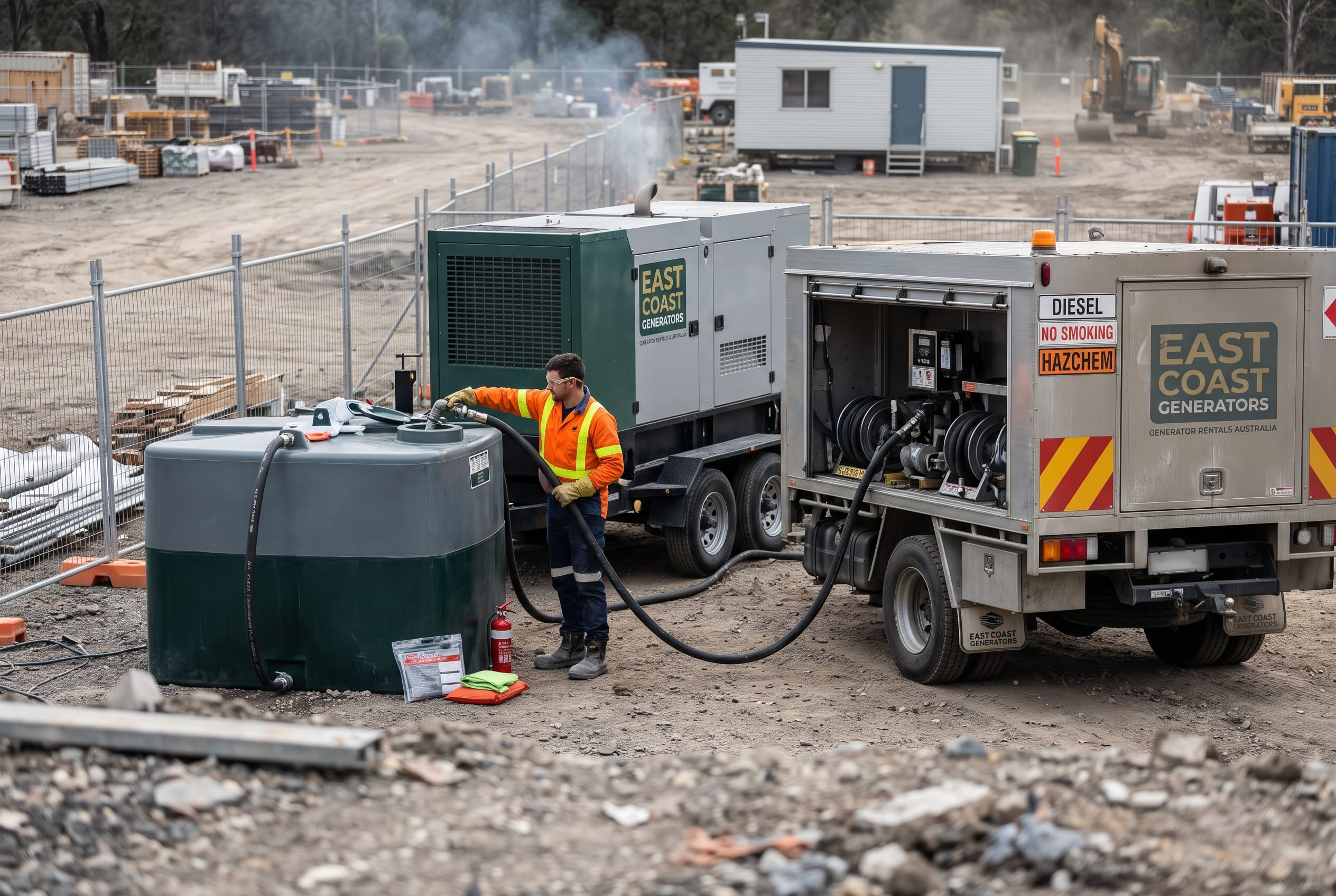
The simplest way to keep a set fuelled on a long job is to have diesel brought to it on a schedule. A mobile refuelling service delivers fuel to the generator on site and tops it up before it runs low, not after. That removes the mid-job scramble and takes fuel off the site crew’s list entirely.
East Coast Generators runs its own fleet of refuelling vehicles and trailers, so deliveries can be planned before, during or after hours to suit the job. The value is in the schedule: fuel arrives on a rhythm matched to the set’s consumption, so the tank never gets close to empty. Diesel is also handled by people who do it every day, with the right equipment, rather than by someone carrying jerry cans across a live site.
That approach holds up in hard conditions. In winter 2010 our team kept a standby set fuelled at Mt Baw Baw Alpine Resort through 1.5 metres of snow, with 1,500 people staying at the resort.
Fuel tank hire to extend run time
Refuelling less often beats refuelling more often. Fuel tank hire adds bulk storage on site, plumbed directly to the generator, so the set runs far longer between deliveries. Our hire tanks range from 450 litres to 105,000 litres. On a remote or hard-to-reach site, that can be the difference between daily deliveries and weekly ones.
A hired tank paired with scheduled refuelling gives the job a large buffer, so one late delivery or a busy week does not put the power at risk. Bulk storage also lets you hold fuel ahead of a long job instead of relying on frequent small drops, and the same tanks can be set up as standalone units with dispensing equipment to refuel other plant on site.
Planning fuel: run hours and a buffer
Good fuel planning starts with the real load, not the nameplate. Consumption depends on how hard the set is working, so work it out in three steps:
- List what the generator will actually run, and size the load with our power calculator.
- Use the fuel consumption calculator to get a litres-per-hour figure for that set at 25, 50, 75 or 100 per cent load.
- Multiply by the run hours you expect, then add a buffer, because jobs overrun and loads climb.
Spare fuel capacity costs little. A set that stops on a critical job costs a great deal more.
On any generator hire in Melbourne that runs across several days, build the refuelling schedule into the plan from day one. A good hire partner will work out consumption for the set and load with you, so the schedule is based on the equipment rather than a guess. If the job is outage cover, our guide to planning for power outages covers the rest of the setup.
Keeping diesel clean
Stored fuel is not always fuel you can trust. Diesel degrades over time, and fuel left in a tank can collect water from condensation or develop microbial growth, especially where tanks sit in the heat or are opened often. Dirty fuel clogs filters and is a common reason a set loses power under load or will not start.
- Use the oldest stock first.
- Check tanks for water and sediment, and change fuel filters as part of regular generator servicing.
- Buy diesel from a supplier who manages fuel quality.
Fresh fuel delivered on a schedule removes much of this risk, because it is used within days of arriving rather than sitting in a drum for months.
Refuelling safely on a long job
Fuel near a hot engine is a real fire risk, and every time someone handles it there is another chance of a spill or a burn.
- Only fill a generator’s own tank with the engine stopped and cooled. Diesel on a hot exhaust or manifold can catch fire.
- Keep a spill kit and a suitable extinguisher at the set itself.
- Do not overfill, and clean up spills straight away.
- Keep ignition sources well away from the refuelling point.
- Store fuel in tanks and containers that meet AS 1940, the Australian standard for flammable and combustible liquids.
Stopping the engine is a problem on a job where the power cannot go off. This is where an external tank earns its place: deliveries go into the tank, away from the engine, rather than through the generator’s own filler, so the set keeps running and nobody handles fuel next to a hot exhaust. Agree how refuelling will work on your site before the job starts. For fire season, our guide to generator safety during bushfires covers placement, fire bans and fuel storage on rural properties.
Fuel handled by people who do it daily
On a long job, fuel is not a background detail. It is what keeps the power on. Honest run-hour estimates, enough storage on site, clean fuel and scheduled deliveries take most of the risk out of it.
East Coast Generators has supplied temporary power across Victoria for more than three decades. Our hire division, Generator Rentals Australia (GRA), matches the set to the job, and we back it with our own refuelling fleet, fuel tank hire and planned onsite refuelling, so the fuel side is handled by our team rather than yours. Whether it is a two-day shutdown or a multi-week programme, the fuel plan is part of the hire, not an extra you chase later.
Book fuel-managed generator hire
If you have a long job coming up and cannot afford the set to stop, talk to us before it starts. We will help you work out run hours, size the storage and set a refuelling schedule that keeps the power on from the first day to the last. Send through a hire enquiry or speak to our team.
Frequently asked questions
What is a mobile generator refuelling service?
A service that delivers diesel to a generator on site and tops it up on a schedule, so it never runs low. It takes fuel management off your crew and keeps the set running through long or critical jobs.
How do I stop a generator running out of fuel on a long job?
Work out run hours against the real load, add a buffer, store enough fuel on site with tank hire, and schedule deliveries before the tank gets low.
Does fuel tank hire reduce how often I need to refuel?
Yes. A larger tank plumbed to the set means it runs much longer between top-ups, which matters most on remote or busy sites. Our hire tanks range from 450 to 105,000 litres.
Can a generator be refuelled while it is running?
A generator’s own tank should only be filled with the engine stopped and cooled. Where the power cannot go off, an external tank lets fuel be delivered into the tank instead, away from the engine, while the set keeps running.
Is old diesel a problem for generators?
It can be. Diesel degrades and can collect water or grow microbes in storage, which can stop a set starting or cut power under load. Use the oldest stock first, keep tanks clean and use fresh fuel delivered on a schedule.