
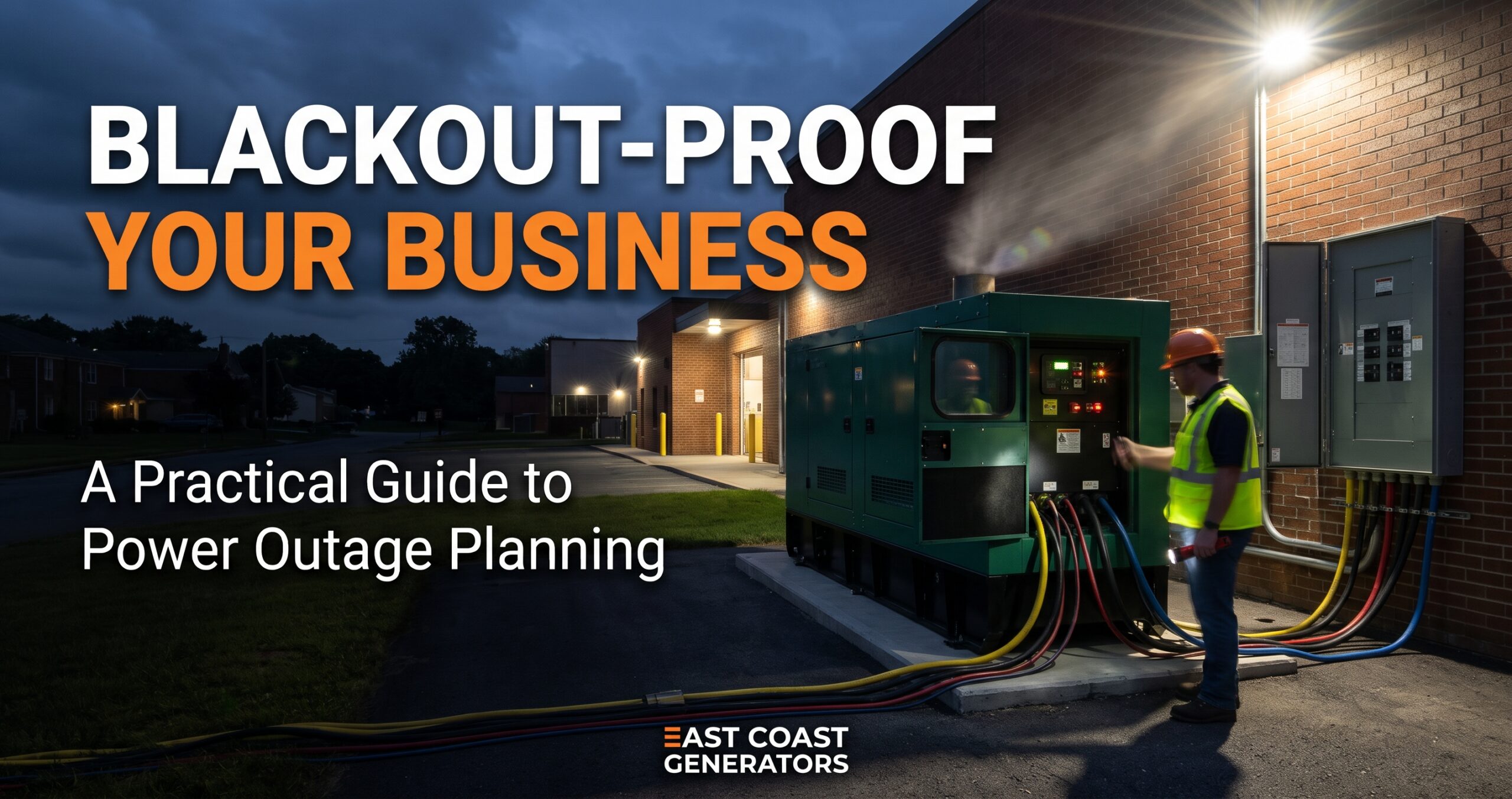
Power outages do not check your calendar. Storms, grid faults, planned network maintenance, a failure in a neighbouring building, a car into a pole down the road: any of them can take a business off supply with no notice. For an office it is an interruption. For a cold store, a factory line, a healthcare site or a data-dependent operation, it can mean lost product, stalled production and customers who go elsewhere.
The useful part is that outage readiness is one of the few risks a business can largely settle in advance. A clear plan, the right standby power and a habit of testing it turns a blackout from a crisis into a managed event. This guide walks through how to plan for a power outage properly: assessing the risk, identifying what must stay on, choosing between standby and prime power, connecting a generator safely, and deciding whether to hire or own the equipment that keeps you running.
Understand your risk and what downtime costs
Start with an honest look at exposure. How often does your area lose power, and for how long? Is there planned network maintenance that will take you off supply? Does your site have a single point of failure that would stop everything?
Then work through what an outage actually costs you, not in a precise figure, but in real terms. Spoiled stock. Halted production and idle staff. Missed orders and service-level penalties. Data loss or systems that take hours to bring back up. Reputational damage if customers are let down repeatedly. For some businesses the cost of an hour without power is minor. For others it is severe and climbs by the minute. The size of that cost is what tells you how much resilience is worth, and it is the honest basis for every decision that follows.
Identify your critical loads
Not everything needs to stay on. The heart of an outage plan is knowing what does. Walk the site and separate the essential from the rest.
Critical loads are the ones that cause real harm if they stop: refrigeration and cold storage, production equipment mid-process, servers and networking, security and access systems, medical or safety equipment, and the lighting needed to keep working and to evacuate safely. Everything else can wait. Sizing standby power to your critical loads, rather than the whole site, is usually more sensible and more affordable than trying to keep everything running. Loads are worked out in kVA, and the surge that motors and compressors draw on start-up has to be counted, not just their running demand.
Standby versus prime power
For most businesses, backup is a standby application. A standby generator sits ready and takes over when the mains fails, running for the length of the outage and then standing down. It is the right fit when the grid is normally reliable and the generator is insurance against the occasional failure.
Prime power is different. A prime-rated set is built to be the main supply for long, continuous running, which suits sites with no grid connection or very frequent, lengthy outages. Most business continuity needs are met by standby power. Matching the duty type to the real situation avoids paying for capability you will not use, or buying a set that is not built for the job you actually have.
Connect it safely: transfer switches
How a generator connects to your building is not a detail to improvise. A generator must never be wired into the mains in a way that can push power back down the network, because backfeeding puts distribution crews at risk and bypasses your switchboard’s protection.
The proper method is a changeover or transfer switch, installed by a licensed electrician in line with the wiring rules. It isolates your installation from the grid before the generator takes the load. A manual switch is fine where someone is on hand to operate it. An automatic transfer switch does the changeover on its own the moment the mains fails, which matters for unattended sites or outages that start overnight. This is the part of an outage plan to get done properly and in advance, not in the dark during the first blackout.
Hire or own your standby power
Whether to hire or buy comes down to how you use it. If you need cover for a defined window, a planned shutdown, a seasonal risk or a temporary site, generator hire keeps your capital free and puts the servicing and readiness on the supplier. You get a prepared set when you need it and hand it back when you do not.
If you have critical loads at risk year-round, owning a standby set through a generator sale often makes more sense, because the equipment is always on site and configured for your installation. Many businesses use both: an owned set for permanent protection, and generator hire to cover peak risk periods, maintenance on the owned unit, or a load that has outgrown it. A generator sale is a larger commitment, so it is worth sizing and specifying with advice rather than guesswork, and worth buying from a supplier who will service it afterwards. There is no single right answer, only the one that fits your risk and your budget.
Test under load, before you need it
A standby set that has never been tested under load is a hope, not a plan. A set that starts and idles is not proven. It needs to run with a realistic load, long enough to confirm it holds up, because a fault that never shows at idle can appear the moment real demand arrives. Schedule regular test runs, keep fuel fresh and rotated, and book a service on time. Whether you hire or own, testing is what turns standby equipment into genuine resilience. Load bank hire lets an owned set be tested under a controlled load without waiting for a real outage to find the weak point.
Write the plan down
Equipment is only half of readiness. The other half is knowing what happens when the power goes out. Write it down: who is called, who connects or starts the set, what gets switched on and in what order, how fuel is topped up on a long outage, and who signs off that the site is safe. A plan on paper, understood by the people on shift, is what makes the equipment work when it counts. Review it as the business changes, because the critical loads of two years ago may not be today’s.
Power resilience, backed by service
East Coast Generators has kept Victorian businesses running through outages for more than three decades, across construction, events, healthcare, manufacturing and critical infrastructure. That is the experience behind the advice above, and it is why we look at the whole picture rather than just selling a set.
For temporary or seasonal cover, generator hire through our hire division, Generator Rentals Australia (GRA), gives you a prepared, well-maintained set with support behind it, and load bank hire to test it. For permanent protection, a generator sale as the Victorian Independent Authorised Dealer for Rehlko puts a new set on your site with our service team behind it, and we handle used stock where that suits the budget. Because we cover generator hire, generator sale, service and 24-hour support together, your outage plan is backed by one team from the equipment to the response. We service every set we hire and every set we sell.
Plan your outage cover before the next blackout
The best time to sort out standby power is while the lights are still on. Talk to East Coast Generators about generator hire for temporary cover, or a generator sale for permanent protection, and we will help you size to your critical loads, connect safely and build a plan you can rely on. Send through an enquiry or speak to our team to blackout-proof your business before the next outage tests it.
Frequently asked questions
1. How do I work out what size generator my business needs?
Start with your critical loads, the equipment that must stay on, and add up their running demand plus the surge that motors and compressors draw on start-up, expressed in kVA. Sizing to critical loads rather than the whole site is usually more practical. A supplier can help you get it right.
2. Do I need a transfer switch?
For any generator connected to your building’s wiring, yes. A changeover or transfer switch, installed by a licensed electrician, isolates your installation from the grid so power cannot backfeed into the network. An automatic switch changes over on its own when the mains fails.
3. Should I hire or buy a standby generator?
For defined or seasonal risk, generator hire keeps capital free and servicing with the supplier. For year-round critical loads, a generator sale often makes more sense. Many businesses do both. Match the choice to your risk and how often you need cover.
4. How often should a standby generator be tested?
Regularly, and under load rather than just at idle. A set that only ever idles is not proven for a real outage. Load bank testing, fresh fuel and on-time service keep a standby set ready. Build testing into your outage plan.